I had every intention of getting this article out prior to Thanksgiving but it was not to be. I think Viognier is a great food wine and wanted to post this prior to the beginning of the holiday season for that reason. It would be a great addition to any holiday table, especially if you want to have something a little different in the line up.
I got irrationally excited when I had the opportunity to purchase a Viognier wine made with grapes from Catie’s Corner vineyard in Sonoma’s Russian River Valley, because I knew I already had Viognier wine in my cellar made with grapes from Catie’s Corner vineyard. This is fascinating to me, how identical grape varieties that grow in the same vineyard, from the same vintage, can create different expressions in wine. And in my world this opportunity doesn’t happen very often.
So how did I find these two bottles of wine? I have been a longtime fan and wine club member of Crux Winery in Sonoma and the bottles I already had in my cellar were from this fantastic small production winery. The other bottle popped up on a retail site that I have become a huge fan of, Wine Spies. They will let you buy as little or as much wine as you like from their one offering a day, and they will keep your wine until you reach 12 bottles, at which time it ships for free. The wines are varied and interesting and I’m a big fan. So, when Wine Spies offered a wine from McKahn Family Cellars of the same varietal and vineyard as one of my favorite Crux wines I immediately bought it.
I couldn’t wait to taste these two wines side by side. It turns out that I had to wait for a few months because Crux had not yet released their 2021 vintage of this wine, but it arrived in my Fall club shipment and so, here we are. Let’s look at the common denominators.
The Grape – Viognier
A white varietal from southern France, best known from the Rhône Valley. It is considered to be a full-bodied white wine, often compared to Chardonnay in that full mouthfeel. It has a telltale characteristic of being unctuous, or “oily”. This might not sound good at first, but think about that super satisfying mouthfeel you get from a great olive oil. That is best descriptor of Viognier to me – satisfying.
The flavor profile is generally stone fruit, citrus, and floral aromas, often with an herbal note, and sometimes even a nutty note. It has great acidity and is incredibly easy to drink. I have come to realize that white wines I love the most have a note of salinity on the finish and to me Viognier has that, along with mineral notes.
The Vineyard
Catie’s Corner vineyard in the northern part of the Russian River Valley. It is considered a cooler spot for growing because in between days with warm afternoons, the vineyard is enveloped by morning and evening fog. It is home to alluvial and loamy soils and is famous for Viognier and Pinot Noir. It is also home to a number of other white grapes varieties, including Grenache Blanc and Malvasia Bianca. Do these grow anywhere else in Sonoma?


Planted in 1988 by Rich and Saralee Kunde, the vineyard is named after their daughter. Although the senior Kundes have passed on, the vineyard is an important resource in Sonoma County, that marked it’s 33rd harvest in 2022. A Sonoma Ag Art vineyard, it is currently farmed by the Dutton family.
The Wines:
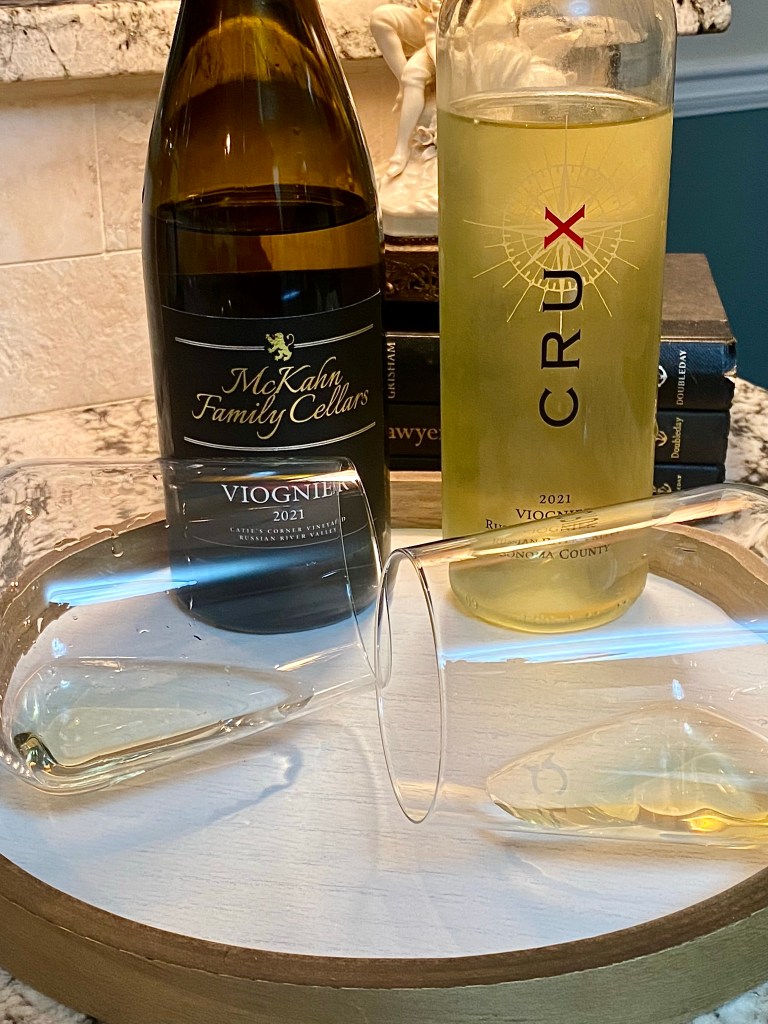
Crux Winery|2021 Viognier|Russian River Valley|13.8% |$34.00
Crux was founded by Brian Callahan and Steven Gower with their first commercial bottling in 2012. The two of them do all of the things to bring their wines to market – from growing and harvesting grapes, to winemaking and marketing. They are mostly direct to consumer, with a total production of about 1,500 cases of wine a year.
They do not grow enough of their own grapes, so they also source grapes from the areas best vineyards, as evidenced here. The philosophy behind all of their wines is low intervention, balanced wines. They do not fine or filter.
The Crux Viognier is whole cluster pressed and then inoculated with commercial yeast for fermentation in tanks only, no barrels. The temperature is controlled throughout fermentation, after which the wine is left on lees for a couple months. It is then brought down to 32 degrees which stabilizes tartrates and compacts the lees, according to winemaker Steve Gower. Once racked, it is blended with 5% Grenache Blanc and bottled.
The first thing I noticed about the Crux Viognier is that it is incredibly expressive – I would say intense aromatics. I wish I could tell you exactly what I wrote down, but I love a wine that smells so good you just want to enjoy that for a minute before you even take your fist sip and this wine checked that box.
Sometimes when a wine is really aromatic it doesn’t hold up on the palate but this wine does. I do recall I got peach, a slight floral note, lemon, tarragon, and mineral notes. On the finish, which is incredibly long, I got that salinity note that I just love.
I did not realize until I began writing that this wine is a wine club member only wine, so if you want to try it you’ll have to join the Crux wine club, or come visit me, I’ll happily open a bottle for you.
McKahn Family Cellars|2021 Viognier|Russian River Valley|13.9%ABV|$45.00
The McKahn Family wine legacy began in 2014, and includes the entire family. They are also Rhône varietal focused and although they have a Napa address, they are committed to finding the best grapes, wherever they may be. From the website:
We are not beholden to any single appellation and will search near and far for a vineyard that will produce fruit that meet our standard. California is blessed with some of the most diverse terroir in the world, and our wines reflect that wealth of diversity from the Russian River Valley to the Napa Valley; from the Sierra Foothills to the Livermore Valley.
https://mckahnfamilycellars.com/the-mckahn-family/
Winemaker Charles McKahn, starts with whole cluster press to tank, where the juice is allowed to settle. After a day or two, the wine is immediately racked off and inoculated with a commercial yeast. The wine is then moved to neutral oak barrels for fermentation to dryness. It is aged in those barrels for 6 months with lees stirring every two weeks for the first three months before bottling. The wine is 100% Viognier.
I do recall that that wine had aromas of citrus, stone fruit and honey. On the palate I got stone fruit and floral notes. I did get a trace of minerality and also the same salinity note on the nice long finish.
My Thoughts
I thoroughly enjoyed both of these Viognier wines. My first comment was “okay, lots of similarities.” My husband however, at the same exact time said “wow really different.” I think that you definitely know you are drinking Viognier and that is why I focused first on the similarities. I also understand why my husband focused on the differences, because there are some, the most notable to me was in the weight and expressiveness of the wines.
Overall, I think that the Crux was far more aromatic and bolder on the palate. Having said that the McKahn was also absolutely delicious, just lighter on it’s feet, so to speak. I also think it had less of that unctuous note.
Do you have a similar comparison to share? I’d love to hear about it.
If you would like to do your own comparison, the Catie’s Corner website lists all of the wineries they grow for in any given year. Obviously this could also be done from any other vineyard but I find this information is sometimes hard to ascertain and the list makes it easy to know where to look.
Cheers wine friends!
 Side Hustle Wino