
I have had this notion rolling around my head ever since we returned from our trip to South America in June of 2023 – I wanted to make empanadas, invite friends over, and open wines that we brought back from Chili and Argentina.
Fast forward nearly 2 years and it hadn’t happened yet. In all fairness, my husband had a stroke in June of 2024 so this past year was not one for entertaining or drinking wine. Then, last week, I was scrolling through the socials and saw that it was #worldmalbecday. On a complete whim I decided to celebrate this wine holiday.
I searched my Cellartracker to see what we had in the way of Malbec, pulled up two empanada recipes I had bookmarked, and pulled the Goya premade and precut empanada dough from my freezer. Truly my intentions for that get together were good, I had started to plan lol!

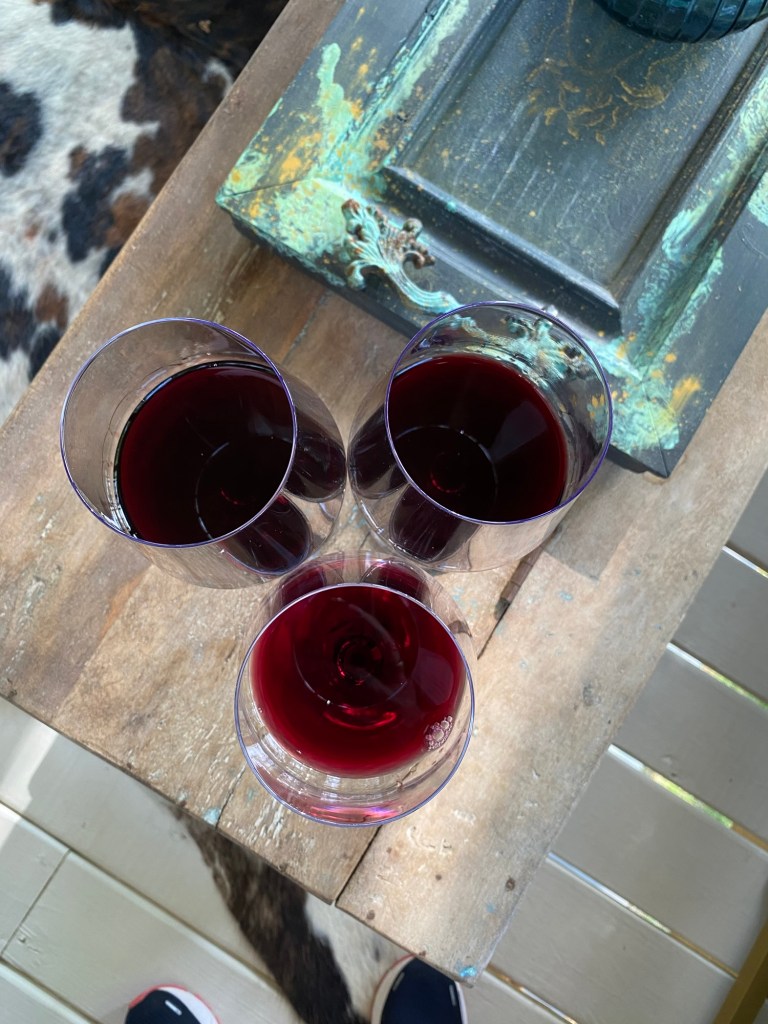
Since we used the Coravin, a proper decant could not be obtained. I did however, let the wines sit in the glasses for about 30 minutes prior to tasting, and incorporated a lot of swirling to get air into the wine and encourage opening. Before I give you our thoughts on the wines, let’s talk about the empanadas!


These little pockets of goodness far exceeded my expectations! I made a beef empanada and a corn empanada and it is hard to say which was better.
The Goya dough was absolutely delicious and my husband was adamant that there was no need to ever attempt my own dough. The Goya does contain some questionable ingredients (sodium benzonate and mono/diglycerides of fatty acids) so I would like to attempt my own dough at some point. From a taste and appearance standpoint, the Goya passes with flying colors. Here are the recipe links for the beef and for the corn. I also made the chimichurri sauce which I highly recommend doing, recipe here.
The Mendoza wine region is located within the Cuyo region of Argentina. Cuyo means desert and I have written about how shocked I was to learn that Mendoza is in fact an arid desert (read here). Very little rain falls on annual basis and the vast majority of water in the region comes from Andean snow melt.
All of the wineries are located in Lujan de Cuyo in the Primera Zone, and all of the wines are high altitude, and all three contain grapes from the Paraje Altamira appellation in the Uco Valley.
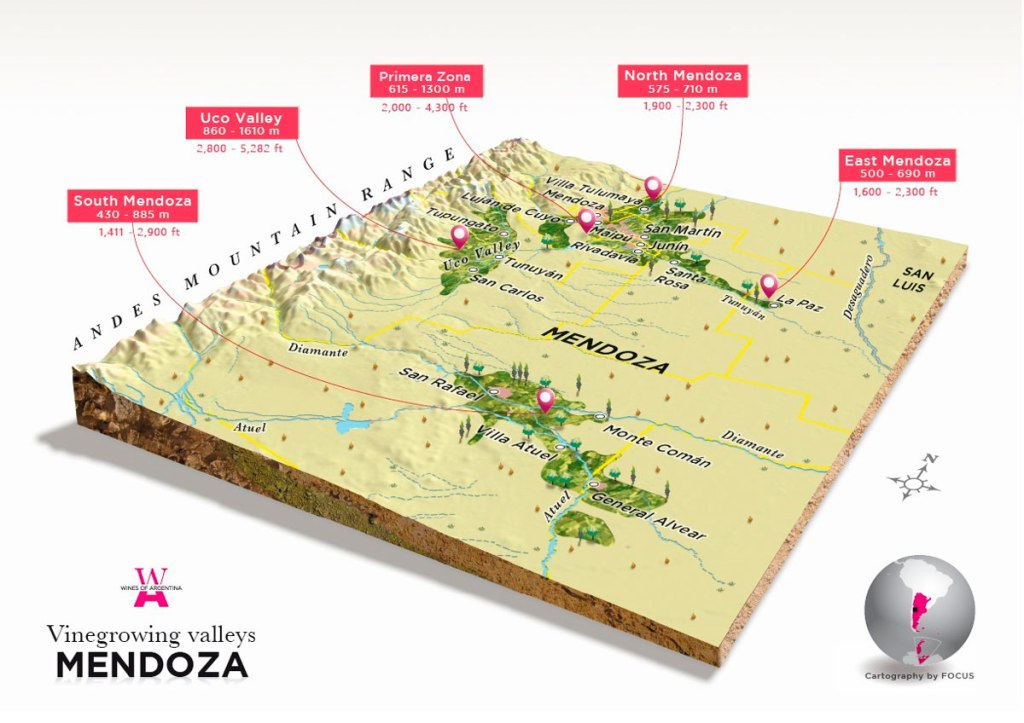
Two of the three are 100% Malbec. Two of the wines share a producer in common. Two of the wines retail for about $80 a bottle and one for $20. The oldest has 12 years of age, and the youngest just three. They range from 13.5% to 14.7% ABV. So let’s compare.
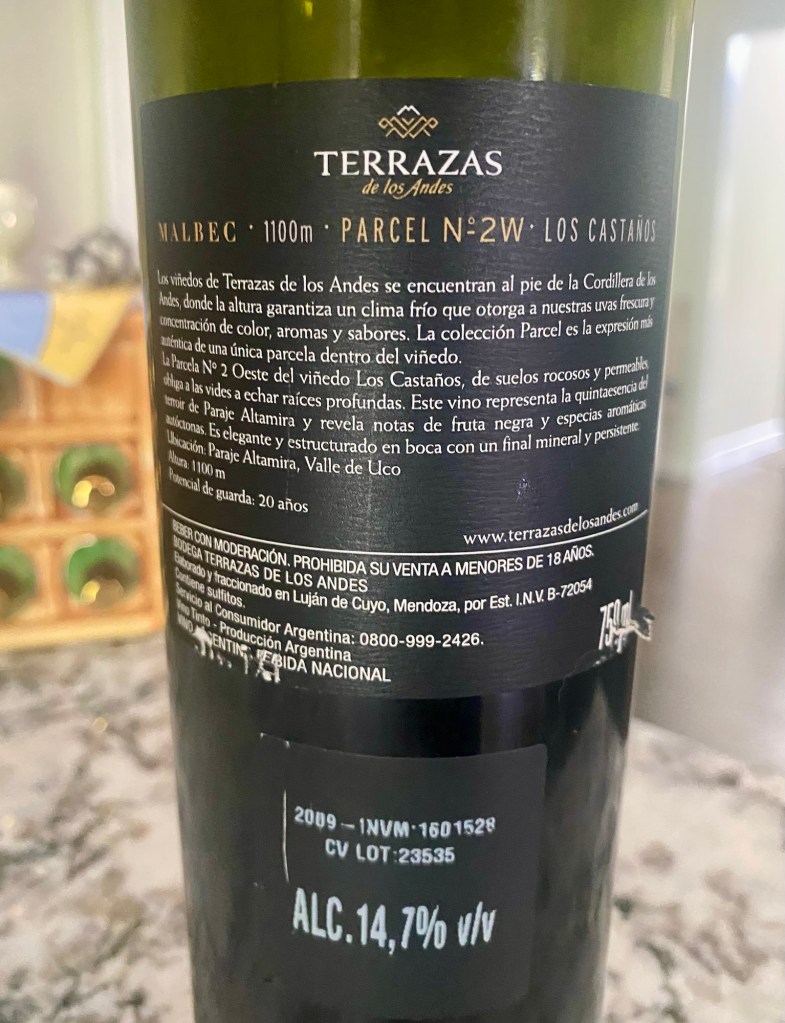
Parcel No. 2W Los Castanos|Paraje Altamira| Terrazas de los Andes|2013|14.7% ABV|$80*

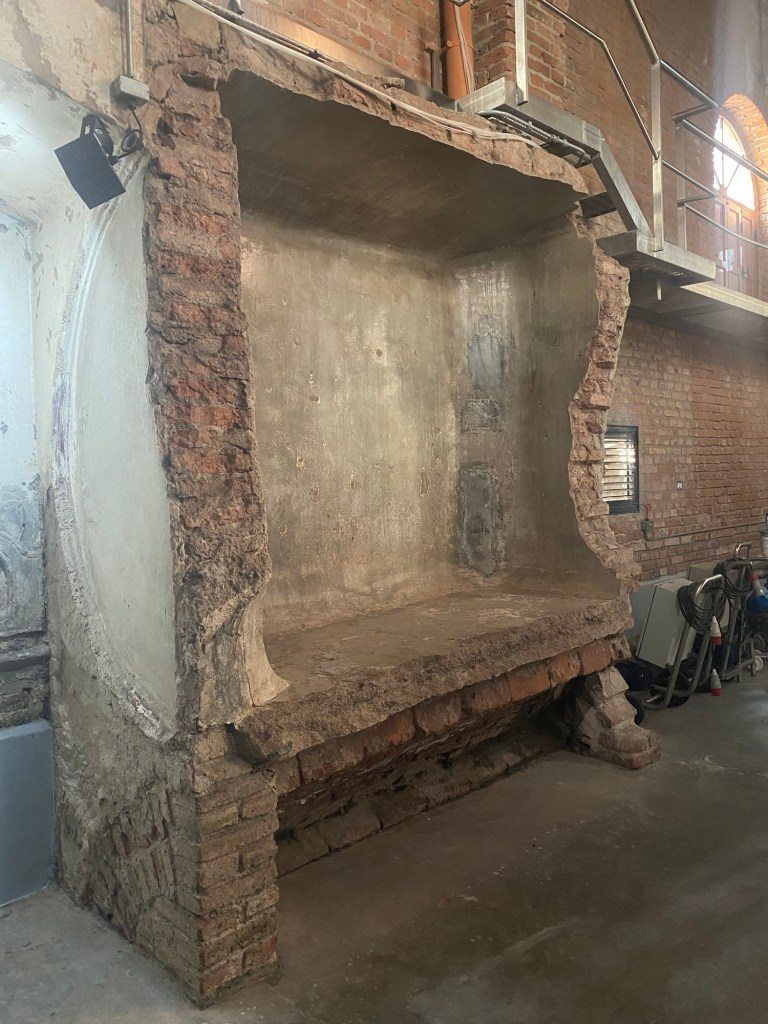
The original winery building at Terrazas was built in 1895 by a man named Sotero Arizu, for his winery called La Perla. In 1985 Terrazas de los Andes bought the property, and under the umbrella of LVMH has created a state of the art facility.
The old:


And the new:


100% Malbec grapes, grown at about 3,600 feet. High altitude allows for more sun in the day and cooler temperatures at night, resulting in a slower, longer and steadier growth cycle. The grapes are from a single plot, No. 2W, in the Los Castanos vineyard. in Paraje Altamira, Uco Valley.
Expressive on the nose with notes of lucious dark fruit, tobacco, and a hint of vanilla. Juicy dark cherry, blackberry, chocolate, and hint of herbal note on the palate. The mouth feel is big and full, yet the tannins were so silky and smooth. The 14.7% ABV is well integrated.
A delicious wine that we can’t wait to actually open and properly decant soon.
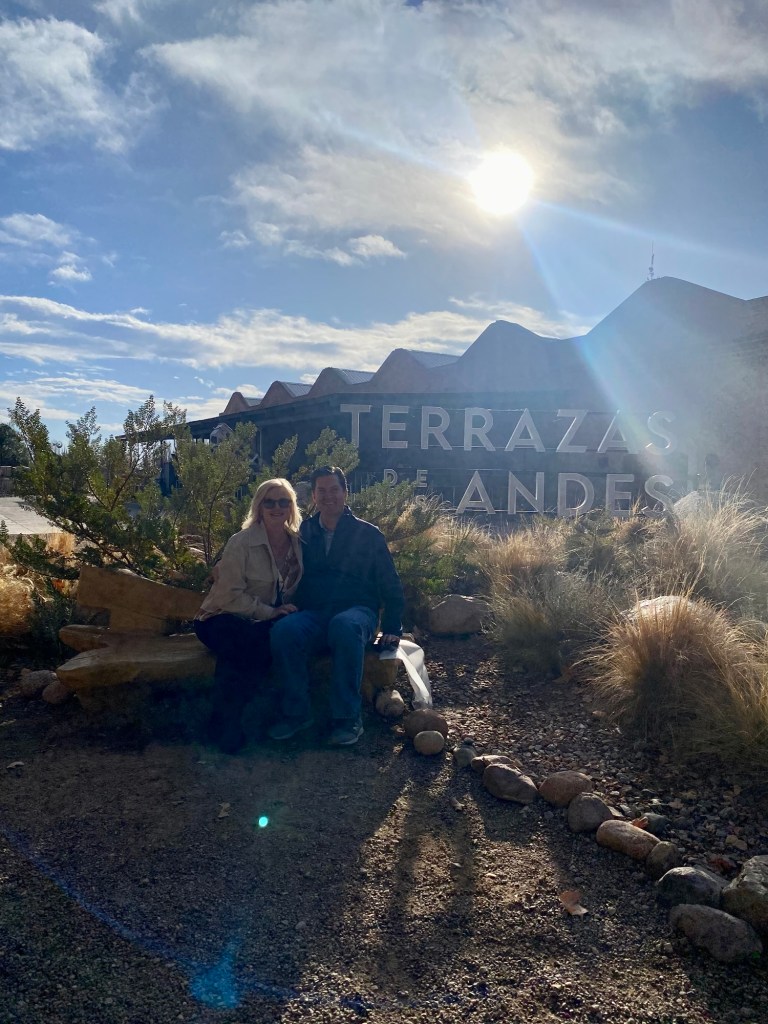
We admittedly might have a slight bias for this wine since we experienced it in person. This wine also has an unfair advantage of considerable age. The wine was as good as we remembered, but at this price it is a high bar and as stated we are biased.
Cheval Des Andes|Cheval Blanc and Terrazas de los Andes|2018|14.5% ABV|$95

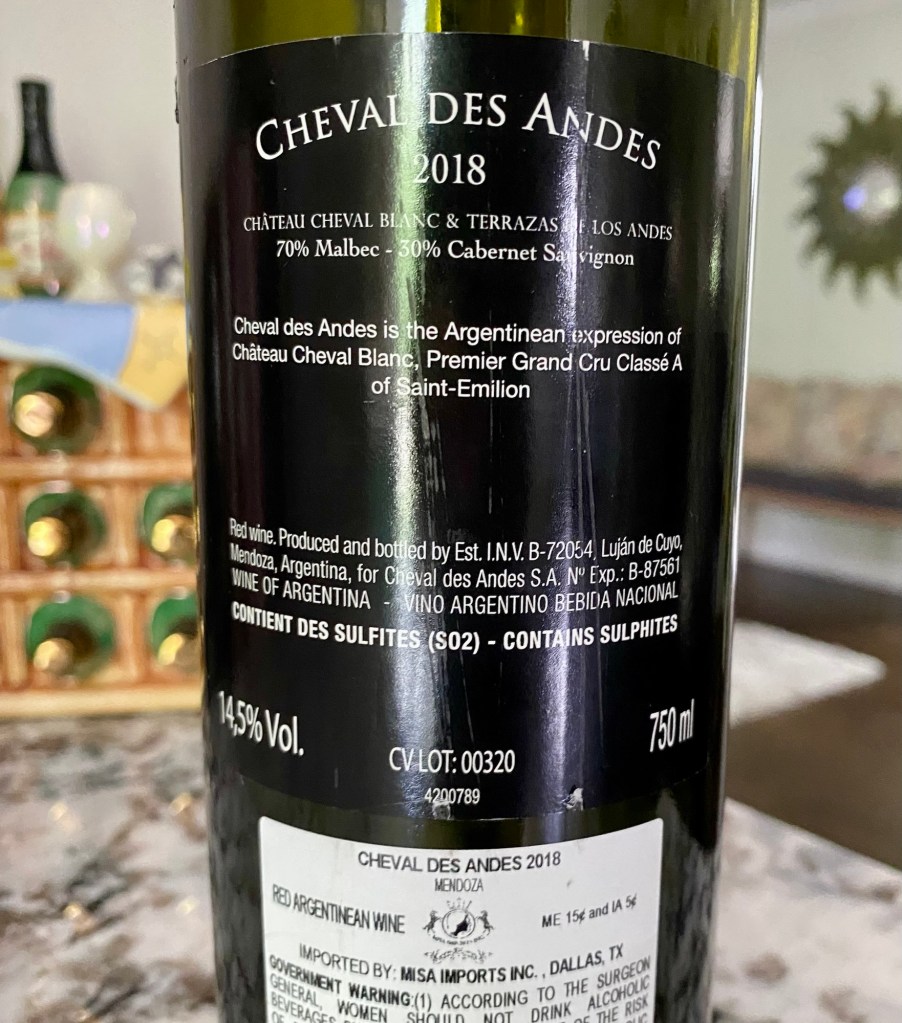
Cheval de Andes is collaboration between Terrazas de los Andes and the famed Cheval Blanc in St. Emilion, Bordeaux. I thought that I would be able to find this wine at the Terrazas winery when we visited, but instead got a kind of mysterious vibe about the whole thing. We were told that Terrazas does not carry the Cheval de Andes on sight, but we could get it at the Cheval de Andes winery.
We didn’t make it Cheval de Andes, so I stopped at the duty free shop at the airport. No luck here and we were told that we could do much better for the money.
I guess there truly is no such thing as bad press because that sealed the deal that I was going to find this wine. I looked online and couldn’t find it available anywhere. Fast forward a few months and the online retailer Wine Spies featured it. Mission accomplished!
The story of Cheval de Andes is tied directly to Cheval Blanc’s Pierre Lurton. He discovered that there were ungrafted Malbec vines growing in the Las Compuertas vineyard in Mendoza. The vines were planted in 1929 from vines brought over from France. The Malbec vines in Bordeaux , had all been grafted to phylloxera resistant rootstock, which Lurton believed affected their quality. Here, he felt, was the true expression of French Malbec. In 1999 a collaboration with Terrazas de los Andes resulted in the birth of Cheval de Andes. I am not sure of the motivation for a collaboration here. Certainly Cheval Blanc has world wide recognition and both Terrazas and Cheval de Andes are part of the LVMH portfolio, so resources run deep for whatever is needed.
Cheval de Andes declares itself to be the Grand Cru of the Andes region. After reading through the website I had the impression that Pierre Lurton is trying to repatriate those imported Malbec vines. It is as though this winery and the wines it produces are French rather than Argentinian. He calls the wine the Argentinian expression of Cheval Blanc. An Argentinian Bordeaux blend. It is a bit of overkill on the French-ness in my opinion. The bottom line is that this is an Argentinian wine, grown in Argentinian soil. The blend of grapes changes from vintage to vintage but this one is certainly Malbec dominant.
The winery is located in Lujan de Cuyo, as is the Las Compuertas vineyard. Made of 70% Malbec and 30% Cabernet Sauvignon, grapes come from Las Compuertas and the Paraje Altamira, both vineyards are at high elevation.
Each plot of grapes is fermented and aged separately in 225 and 400 liter barrels, and foudres (2,500 L). The oak is mostly neutral French, but also Austrian, Slovenian, and Hungarian. An elaborate barrel program!
The goal of this wine is to be complex, and elegant. Ageable, able to cellar for decades. Elegant indeed. Like a whisper of a million different things. We couldn’t pinpoint thoughts on this wine. Ethereal in that the notes fluttered, coming and going too quickly to register.
The problem is, we thought maybe this wine was too elegant for its own good. Beautiful, delightful, a pleasure to drink. But. At this price point, we also wanted a memorable impression. Maybe our palates are not refined enough.
Paraje Altamira|Catena|2022|13.5% ABV|$20

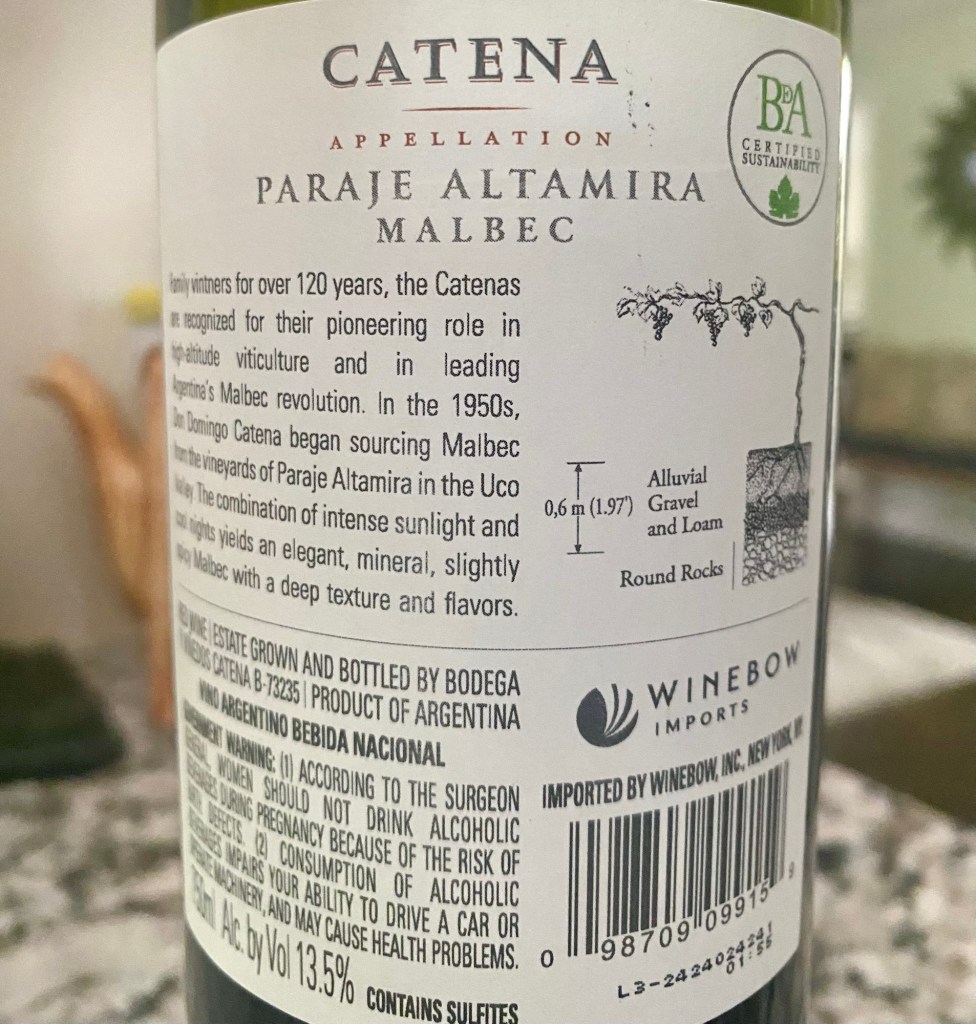
The Catenas are to Mendoza what Robert Mondavi is to Napa. They have passionately advocated for Argentinian wines to claim their spot on the the world stage of serious wine for decades. They have also dedicated themselves to researching and furthering viticulture and oenology of the region. And they have certainly succeeded. The Catena name is synonymous with Argentinian wine.
I was not surprised to read that the Catenas have been sourcing from Paraje Altamira since the 1950’s and were integral in establishing it as an official appellation.
The Catena portfolio is vast and wide, ranging from $20 to several hundred dollar bottles. This wine made its way to me through a local retailer’s wine club – The Marietta Wine Market.
So here is something I found interesting. From the Catena website:
As a Latin country, Argentina shares the Napoleonic Code, and over half of the vineyards in
Mendoza are less than four hectares in size and owned by multiple family members. Each
village has its own culture with favorite foods, winemaking traditions, and distinctive flavors.
Catena’s Appellation wines express the diversity of terroir and the historic farming customs of
these local families –
The sharing of the Napoleonic Code is in reference to Burgundy and even after visiting this region I had no idea this was the case in Mendoza. Fascinating,
100% malbec aged for 12 months in new French oak this wine was the boldest of the wines. I actually wrote “difference between drugstore perfume and Chanel” in reference to this wine versus the other two. This sounds harsh, but you really have to consider the context here. It is a tall order, and probably unfair, to put a $20 bottle of wine up against these other two.
This wine was very fruit forward, with some spice, and a milk chocolate note. I also noted a medicinal note that I sometimes get on Argentinian Malbec, I wrote cough drops, not syrup. All of this sounds pretty dire, but I ended up liking this wine for what it is, an affordable, everyday wine. This wine was the most aromatic, and had the boldest tannins. but was the lightest in color. It also had the lowest ABV at 13.5%.
I am willing to bet this Catena wine is pretty consistent from vintage to vintage, which to me indicates a little more manipulation in the winemaking process. Maybe it is just all that new oak coming through? Either way I’m not judging. The world needs many more bottles of $20 wines than it does $80 and $100 bottles. Especially in the current climate of declining wine sales globally. We need open bottles on tables and Catena deserves accolades for providing accessibility of quality wines at everyday affordable prices.
I had an epiphany in this tasting. There was such a stark difference between the Catena and the other two in boldness and feel. I think this really showcased the difference that age and less intervention – specifically oak – can make on wine. The Catena is big and bold and I think matches the palates of most consumers better than the more subtle profile of the Terrazas des los Andes and certainly the Cheval de Andes.
These epiphanies are why I like to contrast and compare – I learn things.
But I also hate contrasting and comparing because it is a true fact that comparison is the thief of joy!
We will revisit all of these wines on their own and I am very curious to see what we think. Until then, cheers!
 Side Hustle Wino