Lynn Gowdy of Savor the Harvest is hosting a writing event this month that combines several wine writing groups: the French #Winophiles, the #WorldWineTravel group, the #WPWeekend group, and the #ItalianFWT group. The theme for the month is uncharted territory: wines, varieties, or regions, that are new to us.
I knew immediately I was going to write about a bottle of wine my daughter and son-in-law bought back from their honeymoon for us. It has been a conundrum wrapped in an enigma from the moment I received it! Labeled as Red Ginseng Wine from the DMZ (Demilitarized Zone), I have been unable to find a ton of information about it.
I waited until the whole family was together to open it and I think it is fair to say we were all stunned by what we tasted. Not necessarily in a good way. I will dive deeper into that, but first let’s figure out a few things, like what exactly is Red Ginseng Wine? Is it even a wine if its not made from grapes? I will let you argue amongst yourself about that, because it becomes clear pretty quickly this is not a wine at all but a liqueur.
It is labeled as wine and so it took some researching to figure this out. I hope you will stick around and continue reading because this is a very unique little beverage that I thoroughly enjoyed researching.
The Demilitarized Zone (DMZ)
The fact that it comes from the DMZ is perhaps the most special and unique thing about this wine. If you are not familiar, it is a fascinating deep dive and I have linked some sites at the bottom to explore further. Here are some Cliff Notes.
The DMZ is a 2.5 mile border zone between North and South Korea. It was established following the Korean War, as a neutral zone for the two counties to interact in a diplomatic and safe manner. An integral part of the zone is the Joint Security Area that consists of administrative buildings for both North and South Korea, and conference buildings for meetings. Soldiers from from both North and South Korea can enter the DMZ, but cannot cross over the center point of the zone, known as the Military Demarcation Line. This line divides not only the entire area, but the buildings and apparently is even marked down the middle of some conference tables.
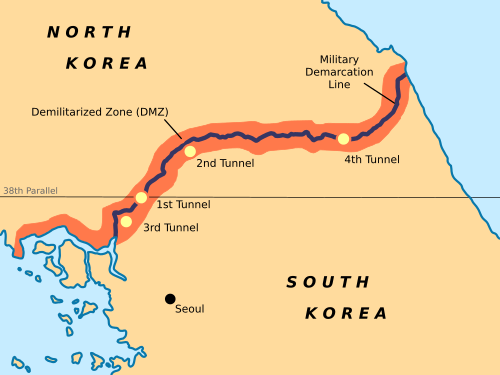
There is an area on the South Korea side of the DMZ, called Freedom Village where about 200 citizens reside. It is governed and protected by the United Nations Command, and the citizens are direct descendants of the people who owned the land prior to the Korean War. North Korea claimed to have a similar area called Peace Village, but it has been discovered that it is basically a movie set with no inhabitants.
The interior of the DMZ may be demilitarized, but both the north and south borders are heavily guarded with a large military presence, barbed wire, and until the last decade or so land mines. There have been several violent incidents over the decades at the DMZ, resulting in the death of hundreds of North and South Korean soldiers and about 50 U.S. soldiers. North Korea was accused of digging tunnels under the zone from 1974 to 1990, some of which are more than a mile long. North Korea denies digging the tunnels, but they do exist, you can even go into the tunnels on the tour.
Historically considered to be a rather hostile place for humans – Bill Clinton called it the scariest place he’s ever seen – it is HUGE tourist attraction with over one million tourists each year. Apparently it had been on my daughter’s bucket list since she learned about it in 5th Grade. She was not disappointed and found the entire experience to be completely fascinating, including the attempted tunnels.
Perhaps the happiest result of the DMZ is the accidental nature preserve that has happened due to the lack of human activity. There are reportedly more than 6,000 species of plants and animals, 100 of which are endangered. In 2005, on a visit to North Korea, Ted Turner offered financial support to turn the area into an UN protected World Heritage Site. While that has yet to happen, South Korea did submit an application for UNESCO designation for the southern part of the habitat. North Korea opposed.
Despite tensions remaining high between the two countries over the last 70+ years, some progress was made since 2018, with both sides demolishing some of their guard towers and decreasing military presence along borders.
There is so much more to talk about here, but this is after all a wine post, so let’s move on.
Red Ginseng Wine
I did not find much information about this Red Ginseng Wine at all. In fact, the more I dug the more confused I got. As noted above, it is in reality a liqueur, with most having an ABV in the 28-34% range. My bottle had an ABV of17%, and I did find one online with an ABV of just 14%, so I had hoped that maybe there was a wine and a liqueur, but I don’t believe that to be the case. I think all Red Ginseng Wine is actually a liqueur.
Made with the Red Ginseng root, rice, and yeast, that mixture is put into an alcohol base for fermentation. It did become clear that the Ginseng is grown and harvested with meticulous care, often noting the age of the root, and sustainable growing practices. I found an article interviewing one producer, who said that the process takes about 100 days to complete:
“First of all, it takes about 100 days to make it. It takes 10 days to manufacture the base liquor, 60 days for main and post-fermentation after soaking the malt, and 30 days for fermenting after brewing” – Master Kim, Chang-soo
Ginseng is well known in Eastern cultures for having many medicinal and health properties, with Red Ginseng being the most revered. The Catonese word for ginseng translates to “human root” because it is essential to human well being. Thought to have properties that improve both physical and mental health, it is also thought to represent longevity and living well. The beverage dates back to antiquity – seriously B.C. – and Koreans claim it as part of their national heritage.

DMZ Chung Jung|Korean Red Ginseng Wine|17% ABV
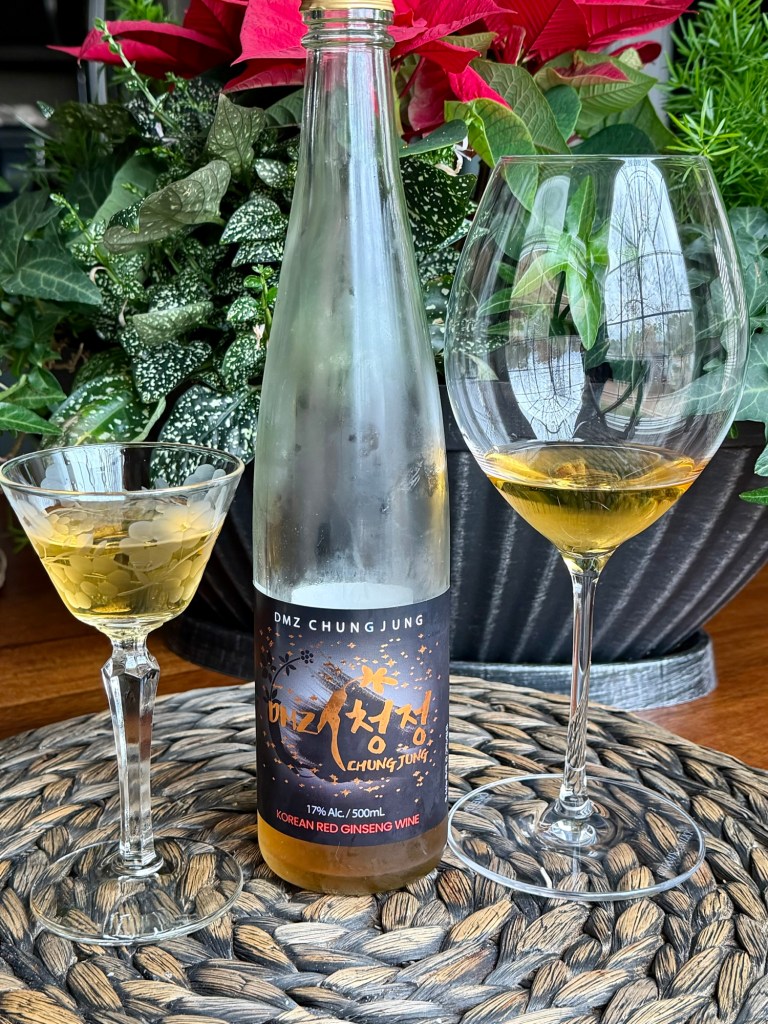
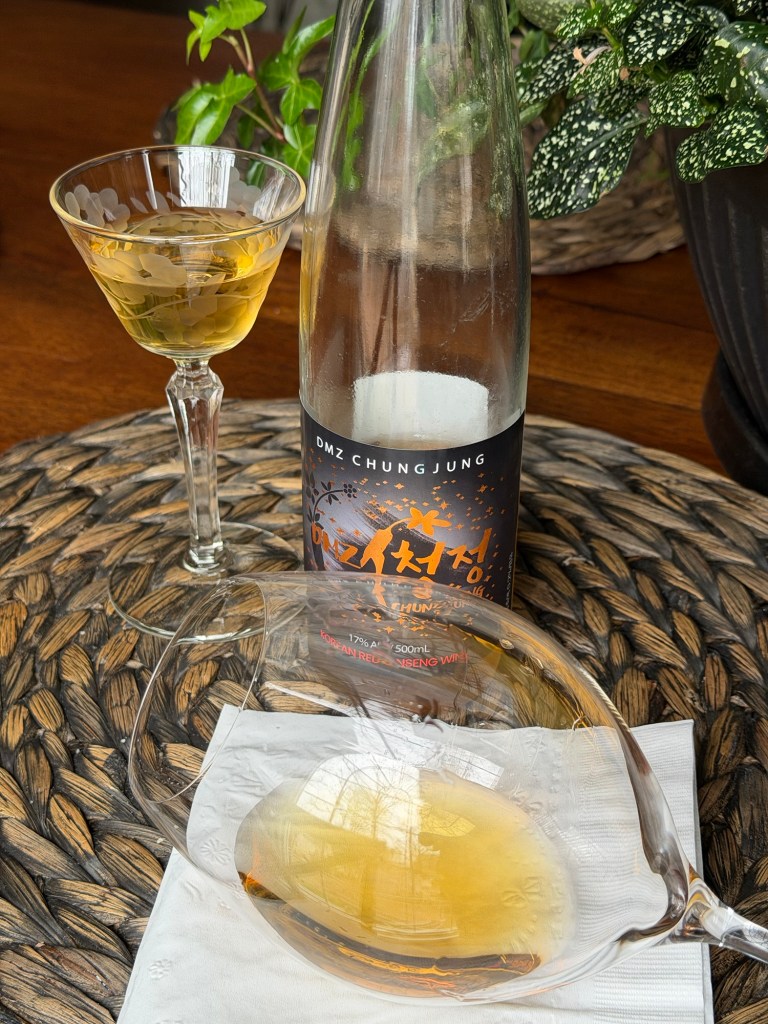

Enter another mystery. I could find no information on Chung Jung, other than a Korean food producer Chung Jung One. So, no idea what that is referencing. I thought maybe a region where Red Ginseng is grown called Chungcheong Province, but after talking with my daughter I discovered that the Red Ginseng for this wine comes from Gaeseong, which she thinks is actually within the DMZ.
So what does it taste like? It tastes and smells like fresh dirt and potatoes! That is not a typo lol! At first I thought maybe this bottle was faulted. It did travel around the world in a suitcase. But I don’t think it is. I think it is a sound representation of this wine, it is just has some interesting flavor profiles.
Despite six of us having a visceral negative reaction on first impression, three of us were intrigued enough to go back in for a second sip. The three of us agreed there was something that was actually good and made you want a little more.
It is intensely aromatic. Just standing in my kitchen with the glass on the counter, if I had been blindfolded, I would have told you we were standing in the middle of a garden with freshly tilled dirt and a fresh potato sliced in half. There is another aroma and I am guessing that it is the Red Ginseng, but I have never had it so can’t say with certainty.
On the palate it has a sweetness. Before discovering that it was a liqueur, I thought maybe it was a dessert wine, like Sauternes or Vin Santo. Those of us who kept tasting agreed that it did have notes of toasted nuts and honey. And there is a nice acidity on the finish.
This bottle is a screw cap and I recapped it and put it in the fridge. A few weeks later we had some friends over. Again, there were six of us, and the same exact reaction happened. Three of us wanted to take another sip, and the other three questioning our sanity.
I found a few notes online that said it has a “mild earthy flavor,” but I must reiterate, there is nothing mild about this wine. It is intensely aromatic with bold flavor. I tried it at room temperature, chilled, with ice, in a wine glass, in a cordial glass. I can say I prefer it chilled or with ice, and the wine glass was much more expressive than the cordial glass. The funniest thing of all is that while writing this I revisited again, right after brushing my teeth. This was actually my favorite experience with this wine lol!
I did see that many bottles for sale online contain an actual piece of Red Ginseng root in the bottle. Mine did not have that but did have some sediment.
This bottle has been opened and in my refrigerator since August. It tastes today exactly the same as it did upon first opening. It truly is a mind blower, and even though I am one of the group that was intrigued enough to keep sipping, the medicinal and health benefits would have to be practically magic for me to seek this out or have any future cravings for it.
In my researching, I did find some DMZ Wild Grape Wine and and apparently there is a Wild Berry Winery that you can visit on the tour. The border between North and South Korea is on the 38th parallel so grapes can potentially grow there.
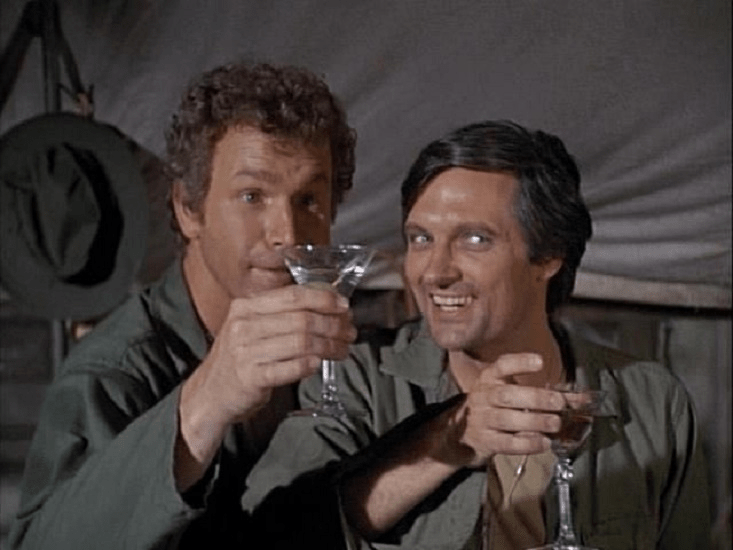
I am left wondering what Hawkeye and BJ were really distilling in their tent? Maybe it was the base for some Red Ginseng Wine?
Please click the links below to read about more first time wine experiences from my fellow wine writers:
David from Cooking Chat shares “Something New: Visiting Wineries in Five States You Might Not Expect“
Deanna from Wineivore shares “The Slovakian Princess Grape: Pesecká Leánka“
Wendy at A Day in the Life on the Farm shares “Exploring Garda Bianco from Poggio delle Grazie as we enter 2026“
Jeff at Food Wine Click! shares “Explore the Wilds of Spain in Priorat“
Jennifer at Vino Travels shares “Where Italy’s Largest Lake Meets the Vineyards: Discovering Garda DOC”
Camilla at Culinary Cam shares “Armenia: A Wine Story Spanning Six Thousand Years“
Lynn at Savor the Harvest I share Wine Explorations 2026: regions, wineries and varieties, featuring négrette and Applegate Valley AVA
SORCES:
https://www.ebsco.com/research-starters/history/korean-demilitarized-zone-dmz
https://en.wikipedia.org/wiki/Korean_Demilitarized_Zone
https://k-ave.com/blogs/brands-stories/ks-insam-wine-%EA%B8%88%EC%82%B0%EC%9D%B8%EC%82%BC%EC%A3%BC
 Side Hustle Wino
What an excellent article. I am leaving this site, much more knowledgeable than when I entered. Thanks.
LikeLiked by 1 person
Thank you Wendy! It was a fun little mystery to expore.
LikeLike
You picked a great one Cathie, I have never heard of Red Ginseng wine. It will be interesting to see what happens with this DMZ zone and the United Nations Command of it with the current administration in the US. I agree with your daughter, what a fascinating experience (it would be). What an intriguing discussion of your initial and second tasting … and that you were pulled back for a second taste! Good point on Hawkeye and BF ;-DDD Thanks for joining this month!
LikeLiked by 1 person
Thanks for hosting Lynn! And for tolerating my liqueur addition 😂
LikeLiked by 1 person
That is very interesting. Thanks for the ALL the info. Who knew??? “Wine” from the DMZ!!!
LikeLiked by 1 person
Right?!? Thanks for reading Julie!
LikeLike
What a wonderfully interesting bottle of wine! I knew ginseng as a medicinal syrup and as a root to put in a traditional Korean chicken soup, but I’ve never heard of a wine made with it. Maybe the wine is considered medicinal too? Thanks so much for sharing this very unusual wine, so we can all taste along too.
LikeLike
Well, you definitely hit the something new theme well for this one! Interesting experience.
LikeLiked by 1 person